


The term “detransitioner” became increasingly visible during the late 2010s, particularly between 2017 and 2020, before entering mainstream political and media discussions around 2021–2023.

There is something rather peculiar about the American conservative movement’s fascination with ‘detransitioners’ and how it has used people in the process. An entire political establishment, not previously celebrated for its sensitivity towards transgender people, has discovered an extraordinary capacity for compassion. Tears, television appearances, congressional hearings, and Christian organisations are falling over themselves to offer a microphone. It’s been a strange development for those who indulge in emotional manipulation and moral duplicity.
At the centre of this spectacle is Chloe Cole, who underwent medical transition as a teenager before subsequently detransitioning. Cole has spoken publicly about regretting her treatment, including a mastectomy at fifteen. Her experience is serious and deserves consideration. But what interests me is not whether Cole has suffered. It is how her suffering became such valuable political property.
Cole is part of a small and increasingly familiar collection of detransition campaigners, including Prisha Mosley, Soren Aldaco, Luka Hein, Cat Cattinson and Abel Garcia. Their names appear repeatedly across conservative media, political hearings and campaigning events. Different people, different experiences, but often remarkably similar destinations. One might reasonably wonder who is arranging the itinerary.
No one is playing a level game; some are funded, and others are cast aside with little, apart from the evidence of their own social media meltdowns and internal conflict with those who promised them a meal ticket or a seat at the Trump Table.
Cole has managed to build a successful brand and media career out of crying on cue and speaking at Christian Conservative dinners.
Enter the organisations.
Detrans United brought detransitioners together for collective advocacy. Partners for Ethical Care organised events and discussions. Independent Women’s Forum provided media platforms, documentaries and an ambassador programme, while Do No Harm, founded by physician Stanley Goldfarb, developed model legislation restricting gender-affirming medical treatment for minors. Cole became one of its most recognisable advocates.
These organisations do not all share the same leadership or necessarily answer to one another. But their activities overlap, and the same personal testimonies circulate between them. It is a curious arrangement in which individual experiences acquire the reach of an organised political campaign while retaining the appearance of spontaneous public concern.
And then, inevitably, God arrives.
Alliance Defending Freedom, the influential international Christian legal organisation, has promoted Cole’s activism and incorporated detransitioner testimony into its corporate campaigning. Focus on the Family and the Colson Centre for Christian Worldview featured Cole in their documentary Truth Rising. Liberty Counsel, another Christian legal organisation, has used her story in arguments concerning religious liberty and Christian counselling.
The religious organisations have their own established positions on sex, gender and sexuality. Cole’s story gives them something particularly useful: a personal account they can present as a warning about medicine, without necessarily starting with a sermon about morality. The theological argument acquires a medical vocabulary, puts on a respectable jacket and heads off to Washington.
But another organisation in this peculiar travelling circus deserves considerably more attention: Genspect, founded by Irish psychotherapist Stella O’Malley in 2021.
Genspect presents itself as an organisation concerned with evidence, safeguarding and alternative approaches to gender-related distress. It has developed a substantial international presence through conferences, publications, podcasts and professional networks. Its activities include Beyond Trans, a support initiative for detransitioners, and Themis, established to provide financial assistance for detransition-related litigation.
O’Malley is particularly interesting because she operates at the intersection of psychotherapy, media and political advocacy. Through her documentary work, podcasts and Genspect’s international conferences, she has helped create a platform where clinicians, journalists, parents, detransitioners and campaigners encounter one another. The language is frequently clinical, but the subjects extend far beyond the consulting room. Gender identity, education, free speech, medical institutions and Western civilisation all find themselves under examination. A rather ambitious appointment for a psychotherapist.
In November 2023, Genspect held its Bigger Picture conference in Denver, Colorado. Among those appearing were Chloe Cole, Stella O’Malley and journalist / lobbyist Michael Shellenberger. Cole participated in a live recording of O’Malley’s Gender: A Wider Lens podcast, while Shellenberger discussed what he regarded as institutional failures surrounding transgender healthcare.
The conference also provides an unusually clear example of how these networks overlap. Genspect’s own programme placed personal testimony alongside political commentary, medical criticism and media strategy. It was not simply a gathering of people sharing difficult experiences. It was a forum for developing and communicating an alternative political and medical understanding of transgender healthcare.
Shellenberger would subsequently become central to another episode: the publication of the WPATH Files in March 2024. These were leaked internal discussions from the World Professional Association for Transgender Health, published with an accompanying report by Mia Hughes through Shellenberger’s organisation, Environmental Progress.
The documents raised questions about clinical practice and professional decision-making. Their interpretation, however, became fiercely contested, particularly where campaigners presented selected conversations as proof of systemic medical wrongdoing.
What makes the episode interesting is O’Malley’s own account of its development. She described learning about the leaked material directly from Shellenberger at a gathering immediately before the Denver conference. Genspect later helped publicise the report and organised discussions about its findings. O’Malley subsequently wrote that her organisation had worked extensively with Shellenberger to help launch the material.
Here we have something more substantial than people coincidentally appearing on the same podcast. We have documented cooperation between an advocacy organisation and a journalist over the promotion of a politically consequential publication.
Musk had purchased Twitter in 2022 and subsequently provided selected journalists access to internal company communications for what became known as the Twitter Files. Shellenberger was among those journalists. He later testified to Congress that he had been invited into the project by Bari Weiss rather than personally selected by Musk.
Shellenberger’s participation in both projects illustrates how the same media personalities could move between controversies concerning censorship, institutional authority and transgender healthcare.
Musk’s ownership of X also gave him an unusually powerful position within the public conversation. His own commentary on transgender issues, combined with the platform’s enormous reach, helped make these disputes highly visible. The distinction matters: providing a platform, publicly endorsing an argument and secretly coordinating a campaign are not the same thing. Nevertheless, ownership of the printing press has always been a rather useful advantage when deciding which arguments reach the public.
From there, the stories travel through Fox News, The Daily Wire, conservative podcasts and Republican political events. Cole has also been represented for speaking engagements by Young America’s Foundation. The same small collection of detransitioners appears repeatedly before enormous audiences, often with little accompanying discussion of those who transitioned and remain satisfied with their treatment.
By the time Donald Trump’s 2024 presidential campaign was in full swing, this political ecosystem had already spent years establishing its arguments. Trump made opposition to what he called gender ideology a prominent campaign theme. His campaign spent millions on advertisements attacking transgender policies, including the now notorious message about Kamala Harris being for they/them while Trump was for you.
It was clever political theatre. Not because it explained transgender healthcare, which it conspicuously failed to do, but because it transformed a complicated medical and ethical discussion into something instantly recognisable: an outsider, a threat and a politician promising protection.
Detransitioner testimony fitted neatly into that narrative. It gave Republican arguments a human face and a story of regret, harm and betrayal. There is no established evidence that Trump’s campaign directed Cole or the other activists, or that their appearances determined the election. The political usefulness of their stories, however, is not difficult to understand.
What bothers me is the selective nature of all this newfound empathy. Where are the comparable conservative media campaigns for transgender people who have benefited from healthcare? Where are the congressional invitations for those who regret being denied treatment? Why does one kind of suffering so readily become a national emergency while another struggles to make it past the reception desk?
There is a difference between listening to somebody’s experience and recruiting that experience into a political crusade. One requires compassion. The other requires a communications department, a legal team, a speaking agent and, apparently, an astonishing number of television bookings.
The American Christian right has spent decades building organisations capable of turning cultural grievances into political campaigns. In the detransition movement, those organisations have found a collection of compelling personal narratives that support their existing objectives. Alongside them sit ostensibly secular organisations, professional commentators, media entrepreneurs and technology platforms whose interests sometimes converge without necessarily sharing a common command.
And perhaps that is the strangest part of the whole business. A political movement that has spent years insisting transgender people are confused about their own identities has suddenly discovered a handful whose accounts it regards as authoritative.
Not because they stopped being transgender, but because they started saying something the movement wanted to hear.
Prisha Mosley’s detransition story has also been promoted by O’Malley, who featured her alongside Chloe Cole and Soren Aldaco at campaigning events. In June 2026, ex-comedy writer and serial online harasser Graham Linehan interviewed Mosley for Genspect, connecting her to the British and Irish gender-critical movement.
What we see is not a wave of “detransition” cases, but a hand-picked media set that can be used, discarded, and forgotten once the Trump Train has passed. If these people need compassion, it certainly will not be coming from individuals who will refer to trans people as victims one moment and then as perverts in the next.
Two people who I have spoken to personally have become caught up in the wheelhouse of the detransition racket, where Hendrix, Erica Moise and Ari Laureano are involved; the story is both tragic and tiresome. This is where the “detrans” story leads you.
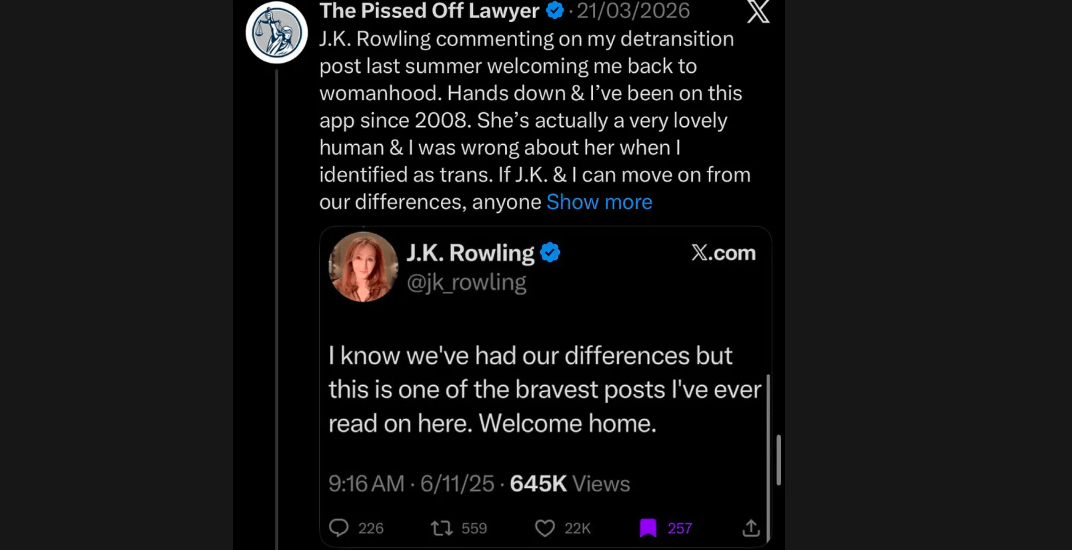
Here is JK Rowling DMing Pissed Off Lawyer (Moise) with her words of support after the announcement of “detransitioning”. They use a method of “love bombing” that is well known in Christian groups, where they offer unwavering support while framing those who discourage involvement as the enemy. It’s a simple technique, and because one side has money and influence, it can suck weak people into its clutches.
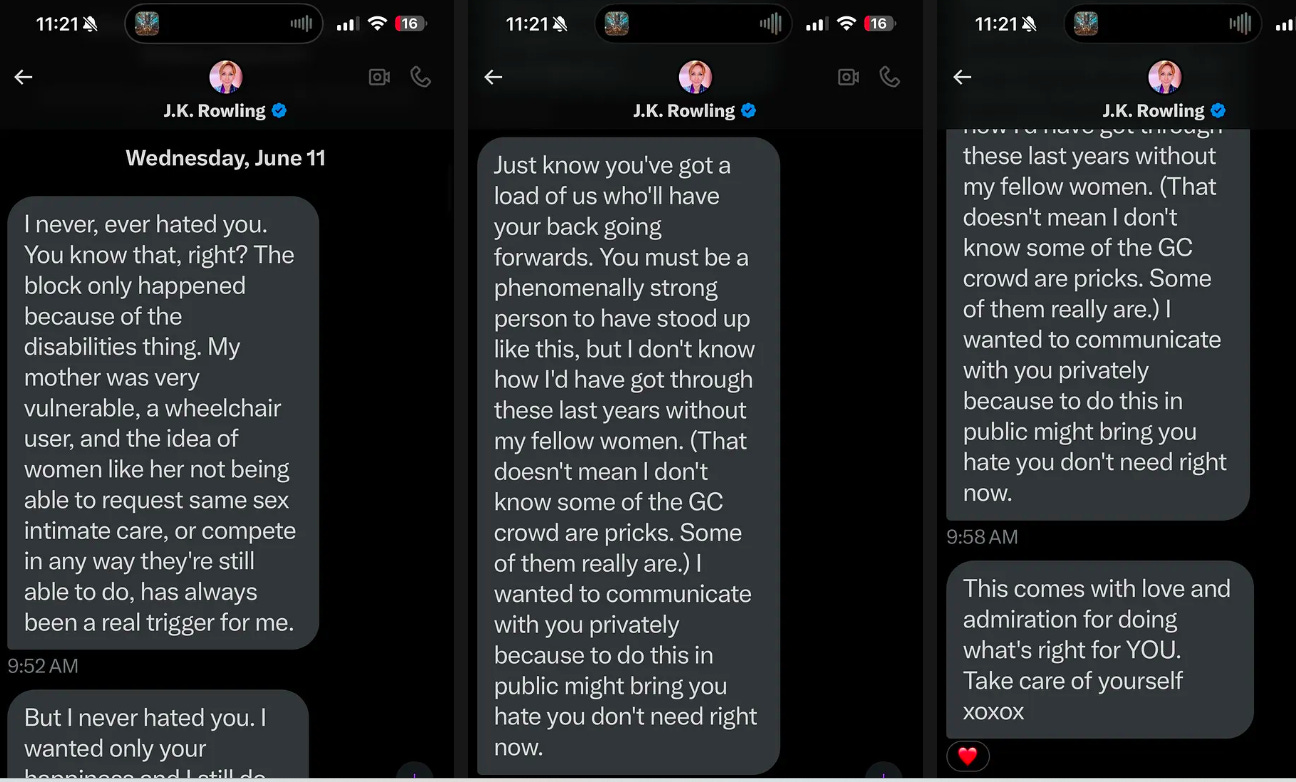
It’s all very creepy and disturbing. This is not new for Rowling. I have further evidence that she contacted individuals in writing, using her own headed, signed paper and an ink pen. It’s all very creepy, manipulative behaviour that targets the vulnerable.
For Ari Laureano, things are even worse.
In late June 2026, Laureano and Moise were assaulted while filming social media videos in Seattle’s Cal Anderson Park
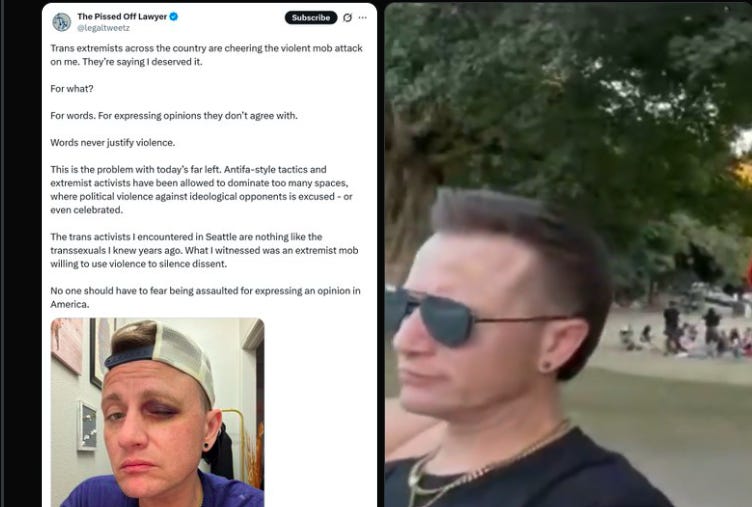
After working with Moise to create media content no one really cared about, they seem to have attached themselves to Andy Ngo’s wing of the Republican media machine.
After attempting to stage a protest by winding up attendees of a Portland Thorns game, she had what looks to be a panic attack and was led out with Brandi Krause, who has become central to Republican media influencing with Andy Ngo. It seems like an attempt at media reach, but it only plays well in their own echo chamber. Trump still looks to be failing in approval ratings.
While Chloe Cole can live comfortably on her media earnings alongside Brandi Krause or Andy Ngo, for the people willing to get hurt and kicked around, there is very little reward.
The compassion, it seems, comes with terms and conditions.
Genspect’s Denver conference programme — confirms Cole, O’Malley and Shellenberger on the same programme in November 2023.
Genspect’s organisational history — documents Beyond Trans, Themis and the WPATH Files campaign.
Stella O’Malley on the WPATH Files — her firsthand account of Shellenberger discussing the leaks before the conference and Genspect’s subsequent promotional activities.
O’Malley’s account of the Lisbon conference — explicitly describes Genspect’s work with Shellenberger on the launch.
Shellenberger’s congressional testimony (PDF) — explains his participation in the Twitter Files and how access to Musk’s company records was arranged.
Brandi Kruse tells Laura Ingraham about being forced out of Portland soccer game: ‘We did nothing wrong’